
Welcome
Login:   Pass:     Register - Forgot Password - Resend Activation

Forum Messages Posted by Roswitha

(4132 Messages in 414 pages - View all)
<<  ... 26 27 28 29 30 31 32 33 34 [35] 36 37 38 39 40 41 42 43 44 ...  >>


Thread: the killing continues, GAZA

341.       Roswitha
4132 posts
 04 Jan 2009 Sun 03:25 pm

UNITED NATIONS – The United States late Saturday blocked approval of a U.N. Security Council statement calling for an immediate cease-fire between Israel and Gaza´s Hamas rulers, diplomats said.


Egypt´s U.N. Ambassador Maged Abdelaziz said it was regrettable that one permanent council member — a clear reference to the U.S. — refused to accept any statement at a time when "the aggression is escalating and more people are dying and the military attack on the ground is at its full scale."


More than 480 Palestinians have been killed and nearly 3,000 injured in Gaza, and four people have been killed in Israel.


US blocks UN statement on Gaza


what can be said here.... clearly, there is no god

That is worse than DRESDEN, at least people could flee there, but this is unspeakable, you comment is correct, Catwoman, NEREDE ALLAH???

Do Israel pilots feel happy killing innocent women and children?

OH, YES, THEY ARE, RABBIS TURNED ON  LOUSSPEAKERS AND FELT HAPPY WITH ALL THE OTHER FANATICS

Do Israel pilots feel happy killing innocent women and children?

A Palestinian in Gaza chronicles life under Israeli bombardment

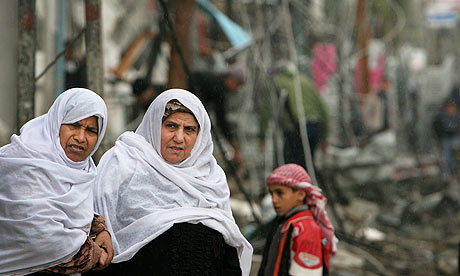
The aftermath of an Israeli missile strike on Rafah refugee camp in Gaza

Palestinians survey the aftermath of an Israeli missile strike on the Rafah refugee camp in Gaza. Photograph: Khalil Kamra/AP

Saturday 27 DecemberI go to visit friends in the Block J neighbourhood in Rafah in the south of the Gaza Strip. While I am in a friend´s house, my phone rings. It´s a friend from Gaza City, calling for a chat. Suddenly I hear the sound of an explosion at his end. At the same time I hear an explosion in Rafah too. Just outside, somewhere near. My friend says: "Fida, they are attacking nearby." I say: "They are attacking here too."


I run into the street and everybody is running, children and grown-ups, all looking to see if their relatives and friends are alive. It is the time for children to go to school for the second shift, after the first shift finishes at 11.30am.Naama is aged 13. This is what she tells me: "I was sitting in the classroom with my friends when the attack happened. We were scared and we ran out of our school. Our headmaster asked us to go home. We saw fire everywhere."

People are looking at the remains of a police station. There are still bodies under the wreckage. It is scary because the attack isn´t over, and from where we are we can see an Israeli airplane attacking another police station.

At the hospital, I speak to a wounded police officer, aged 39. "We were at the police station," he said. "The Israeli planes came and suddenly the building collapsed on us. I saw four dead bodies near me. They were in pieces. Outside there were more bodies. Everyone was shouting. I lost consciousness and then found myself in hospital."

Later I am at home with my family. We´ve just received a phone call on our land line. It´s the Israeli defence ministry, and they say that any house that has guns or weapons will be targeted next, without warning and without any announcement. Just to let you know, we don´t have any weapons in our house. If we die please defend my family.

Sunday 28 December

I wake up at 7am after an Israeli F-16 attack. Our house is shaking. We all try to imagine what has happened, but we want to at least know where the attack was. It is so scary. We try to open the main door to our flat, but it´s stuck shut after the attack. I have to climb out of the window to leave the house. I am shocked when I find out our neighbour´s pharmacy was the target. It is just 60 metres from our house. They targeted a pharmacy. I still can´t believe it.

Om Mohammed says: "They [Israeli forces] attack everywhere. They have gone crazy. The Gaza Strip is just going to die ... it´s going to die. We were sleeping. Suddenly we heard a bomb. We woke up and we didn´t know where to go. We couldn´t see through the dust. We called to each other. We thought our house had been hit, not the street. What can I say? You saw it with your own eyes. What is our guilt? Are we terrorists? I don´t carry a gun, neither does my girl.

"There´s no medicine. No drinks, no water, no gas. We are suffering from hunger. They attack us. What does Israel want? Can it be worse than this? I don´t think so. Would they accept this for themselves?

"Look at the children. What are they guilty of? They were sleeping at 7am. All the night they didn´t sleep. This child was traumatised during the attack. Do they have rockets to attack with?"

Monday 29 December

The Israeli army is destroying the tunnels that go from Rafah into Egypt. For the past year and a half the Israeli government has intensified the economic blockade of Gaza by closing all the border crossings that allow aid and essential supplies to reach Palestinians in Gaza. This forced Palestinians to dig tunnels to Egypt to survive. From our house we can hear the explosions and the house is shaking.At night we can´t go out. No one goes out. If you go out you will risk your life. You don´t know where the bombs will fall. My mother is so sad. She watches me writing my reports and says: "Fida, will it make any difference?"

Before the attack started we got some food aid from the EU. It´s not much, but it´s enough, we´re not starving. But some of our friends have nothing. My mum warns me: "Fida, don´t leave the house, it´s too dangerous outside." Then she goes out to share our food with the neighbours who have nothing.

Wednesday 31 December

11.40pm: a powerful air strike somewhere nearby. I was sleeping but the blast wakes me up. I see my mum looking from the window. She points at one of the refugee camps. "The attack was there," she said.

I went back to sleep – not because I don´t care, but because I can´t deal with it. If the attack was really aimed at one of the camps that means hundreds are going to be injured or even killed, the houses destroyed. I really can´t imagine it.

Thursday 1 January

In the morning I get up early and call a friend who lives in Alshabora camp. He confirms the attack had hit there and I go to meet him.

It looks like an earthquake. Many houses have been damaged, and many people have been wounded. The people who had escaped injury were trying to clean the place up – they have nowhere else to go. But the biggest shock is when I ask about the target. It was the children´s playground.

"We heard a strong explosion happen, but with all the smoke and the dust we couldn´t see well, and the electricity was off," I am told by a small child.

"We saw everything fall down – the window broke on us. We went downstairs, and people were saying that the playground´s been targeted. This park is not a member of Hamas, it´s a park for playing. It´s for civilians – so why did they attack it?," asks one 12-year-old girl who lives nearby.

The target was a civilian area – but there was no warning, not one phone call from the Israeli army to tell civilians to beware.

I visit the main hospital in Rafah. There are so many injured people, most of them children. In one ward, I meet four children aged five or six. They are in deep shock. They can´t speak, they just look at you.

Only one child could say his name: "Abdel Rahman". That´s all he can say. Otherwise, he just stares. He´s five. His ear was wounded by shrapnel, his head is covered by bandages.

There is a 16-year-old girl also suffering from shrapnel injuries. Three of her brothers were killed; all her family were injured. She looks like a zombie and says nothing at all. Her mother is dying in the intensive care unit.

The hospital manger, Abu Youssef Alnajar, gives the statistics for 1 January: two dead – a young man aged 22 and a woman aged 33; 59 injured – 16 children, 18 women and the rest old people. Most of them had been sleeping when the bombs dropped.

I go back home and the first thing I do is take a shower. I feel really upset after what I have seen. As always I am trying to cope with the situation but sometimes it is too much to deal with.

A short message to the pilots in the Israeli F-16s: does it make you feel happy to kill Palestinian children and women? Do you feel it´s your duty? Killing every child and woman, man and teenager in Gaza? I don´t know what exactly you feel, what exactly you think, but please think of your mother and sister, your son and daughter.

Friday 2 January

I am in the hospital again. An ambulance crew has been called out to help an injured man somewhere near the ruins of the old Gaza airport. He´s a civilian, one of the bedouin who tend their sheep in that area. Four shepherds saw an explosion and went to investigate – when they arrived at the scene there was a second bomb and they were injured. An ambulance managed to rescue three of the men. But one of their friends is still there, bleeding.

The ambulance crew are afraid to go back for him. The wounded man is just 50 metres away from the green line so they are afraid the Israeli soldiers will target them.Outside there are still planes in the air. I have just heard a big explosion on the border area.

• Fida Qishta is a freelance Palestinian television producer and writer based in Gaza´s southern township of Rafah


Thread: the killing continues, GAZA

342.       Roswitha
4132 posts
 04 Jan 2009 Sun 06:15 am


In Rafah inspizieren Palästinenser einen Raketeneinschlag


Thread: the killing continues, GAZA

343.       Roswitha
4132 posts
 04 Jan 2009 Sun 05:43 am

Riot police called out in London as protest ends in skirmishes


Riot police were dispatched to the Israeli embassy in London last night as a day of protests across Europe degenerated into ugly skirmishes.


In London Israeli flags were set ablaze and surging crowds were penned back by police with shields and batons. Some protesters were in tears, claiming they were being stopped from leaving peacefully, and organisers said they would complain about police heavy-handedness. Others, growing more aggressive as news of Israel´s ground invasion spread, threw missiles while police tried to drive them back. Late into the evening, several hundred were still staring down officers outside the embassy.

The London ambulance service said it had helped one man with a head injury and others with minor bruises after sending a team of 25 to the scene.

Tens of thousands initially took to the streets, even as Israeli forces were firing shells from the border of Gaza. In London, where the largest rally was held, Trafalgar Square turned to a sea of black, white, red and green – Palestinian national colours – as what organisers claimed were up to 55,000 people showed up in the largest British demonstration for the Palestinian cause. Police claimed the size of the protest was far lower.

In the crowd was the singer Annie Lennox, the comedian Alexei Sayle, Tony Benn and George Galloway. Lennox told the crowd: "We are looking at a huge human rights tragedy in front of us. The idea of an air assault combined with a ground war in such a tightly packed area as Gaza is unimaginable. It will be a bloodbath. Hopefully now we will see dialogue, dialogue, dialogue."

The thrust of the protest was aimed at the British government´s inaction over the Israeli attacks on Gaza, as the onslaught started its second week. One marcher, Omar Lemrini, 45, helped to carry a fake coffin covered in images of dead civilians and children. "This is the second Holocaust," he said. "It´s a question of conscience now."

Some 30 organisations, including the British Muslim Initiative, the Stop the War Coalition and the Palestine Solidarity Campaign, joined forces for the protest. Hemmed in by police, the marchers resorted to the symbolic throwing of shoes into Downing Street. Hundreds of old shoes were hurled over barriers and gates to represent the Palestinian lives lost in the bombing. The gesture echoed the protest by Iraqi journalist Muntadar al-Zaidi, who threw his shoes at President Bush last month in protest at US "war crimes".

David Carr, 45, a nurse, contorted his face in fury as he picked up his battered brown shoe and tossed it over the railings: "I helped search for the people who were injured in the London bomb blast, so I know what it means," he said. Two people broke through the police barrier to make a dash for Downing Street.

The protests were mirrored elsewhere with marches in France, Germany, Greece, Ireland, Italy, Spain, Holland and Turkey. In Edinburgh and Glasgow, around 1,000 were involved in marches which police said passed peacefully. In Paris, 20,000 demonstrators descended on the city centre chanting "Israeli murder".


THE INDEPENDENT


Thread: the killing continues, GAZA

344.       Roswitha
4132 posts
 04 Jan 2009 Sun 03:36 am

pictures tell mor than words:


http://www.msnbc.msn.com/id/28435441/displaymode/1107/s/2/framenumber/9/


Thread: Hierapolis-Kastabala

345.       Roswitha
4132 posts
 04 Jan 2009 Sun 03:01 am

Anybody here to translate this article step by step into English?


 http://www.tuba.gov.tr/index.php?id=433


It is a big shame and scandal that nowadays some local moneyowners and some big politician-bosses plan to build a cement factory right on top of this extremely precious site considered as the Efesus of the Eastern Turkey. The protests and campaigns of environmental groups and individuals continue.

This is a very beautiful but little visited place. A powerful medieval castle (the local name Bodrum Kale is a corruption of Petrium, the Castle of St. Peter) dominates the Roman ruins of ancient Castabala / Hierapolis. The site is not excavated and there are no modern intrusions within sight.

from the book Eastern Turkey by Müjde & Sevan Nishanyan:

Castabala was the capital of the ancient Cilician kingdom, which ruled under Roman aegis just before and after the year 0. Cicero, the roman orator, was briefly proconsul here. His hand-picked king of Cilicia, Tarcondimotus, betrayed Pompey in his war against Caesar. Lucan makes him deliver a long speech about political morality in his Pharsalia.

The original fortifications go back to Roman times or earlier. They took their final shape under the Armenian rulers of Cilicia in the 12th century. New evidence show that the Europeans learnt much of their craft from local - primarily Armenian - builders.


http://www.trekearth.com/gallery/Middle_East/Turkey/photo953257.htm


Thread: John Pilger

346.       Roswitha
4132 posts
 04 Jan 2009 Sun 02:52 am

An investigation into the crippling levels of debt paid by Third World countries.

John Pilger and David Munro examine the policy of First World banks agreeing loans with Third World countries, who are then unable to meet the cripling interest charges.


The film questions whether poor countries will ever develop while burdened with massive debts to the West.

The role of the World Bank, IMF and corporatism comes into direct conflict with the nature of civilian life.

Won Geneva International TV Award at the North-South Media Encounters event, Geneva, 1993


http://video.google.com/videoplay?docid=-5399796928596929639&ei=M6pLSYb3IY62iAKf77XKC


Thread: the killing continues, GAZA

347.       Roswitha
4132 posts
 04 Jan 2009 Sun 02:43 am

BBC  Dec. 20,   2008


http://news.bbc.co.uk/2/hi/programmes/from_our_own_correspondent/7792654.stm


Thread: the killing continues, GAZA

348.       Roswitha
4132 posts
 03 Jan 2009 Sat 05:05 pm

The article that caused the UN Special Rapporteur on the situation of human rights in the Palestinian Territories to be DENIED ENTRY to Israel 2 weeks ago…he was predicting exactly what we are seeing today…more death and destruction and occupation.


And what rough beast, its hour come round at last,
Slouches towards Bethlehem to be born?
William Butler Yeats, The Second Coming


There is little doubt that the Nazi Holocaust was as close to unconditional evil as has been revealed throughout the entire bloody history of the human species. Its massiveness, unconcealed genocidal intent, and reliance on the mentality and instruments of modernity give its enactment in the death camps of Europe a special status in our moral imagination. This special status is exhibited in the continuing presentation of its gruesome realities through film, books, and a variety of cultural artifacts more than six decades after the events in question ceased. The permanent memory of the Holocaust is also kept alive by the existence of several notable museums devoted exclusively to the depiction of the horrors that took place during the period of Nazi rule in Germany.

Against this background, it is especially painful for me, as an American Jew, to feel compelled to portray the ongoing and intensifying abuse of the Palestinian people by Israel through a reliance on such an inflammatory metaphor as ´holocaust.´ The word is derived from the Greek holos (meaning ´completely´ and kaustos (meaning ´burnt´, and was used in ancient Greece to refer to the complete burning of a sacrificial offering to a divinity. Because such a background implies a religious undertaking, there is some inclination in Jewish literature to prefer the Hebrew word ´Shoah´ that can be translated roughly as ´calamity,´ and was the name given to the 1985 epic nine-hour narration of the Nazi experience by the French filmmaker, Claude Lanzmann. The Germans themselves were more antiseptic in their designation, officially naming their undertaking as the ´Final Solution of the Jewish Qestion.´ The label is, of course, inaccurate as a variety of non-Jewish identities were also targets of this genocidal assault, including the Roma and Sinti(´gypsies), Jehovah Witnesses, gays, disabled persons, political opponents.

Is it an irresponsible overstatement to associate the treatment of Palestinians with this criminalized Nazi record of collective atrocity? I think not. The recent developments in Gaza are especially disturbing because they express so vividly a deliberate intention on the part of Israel and its allies to subject an entire human community to life-endangering conditions of utmost cruelty. The suggestion that this pattern of conduct is a holocaust-in-the-making represents a rather desperate appeal to the governments of the world and to international public opinion to act urgently to prevent these current genocidal tendencies from culminating in a collective tragedy. If ever the ethos of ´a responsibility to protect,´ recently adopted by the UN Security Council as the basis of ´humanitarian intervention´ is applicable, it would be to act now to start protecting the people of Gaza from further pain and suffering. But it would be unrealistic to expect the UN to do anything in the face of this crisis, given the pattern of US support for Israel and taking into account the extent to which European governments have lent their weight to recent illicit efforts to crush Hamas as a Palestinian political force.

Even if the pressures exerted on Gaza were to be acknowledged as having genocidal potential and even if Israel´s impunity under America´s geopolitical umbrella is put aside, there is little assurance that any sort of protective action in Gaza would be taken. There were strong advance signals in 1994 of a genocide to come in Rwanda, and yet nothing was done to stop it; the UN and the world watched while the 1995 Srebrenica massacre of Bosnians took place, an incident that the World Court described as ´genocide´ a few months ago; similarly, there have been repeated allegations of genocidal conduct in Darfur over the course of the last several years, and hardly an international finger has been raised, either to protect those threatened or to resolve the conflict in some manner that shares power and resources among the contending ethnic groups.

But Gaza is morally far worse, although mass death has not yet resulted. It is far worse because the international community is watching the ugly spectacle unfold while some of its most influential members actively encourage and assist Israel in its approach to Gaza. Not only the United States, but also the European Union, are complicit, as are such neighbors as Egypt and Jordan apparently motivated by their worries that Hamas is somehow connected with their own problems associated with the rising strength of the Muslim Brotherhood within their own borders. It is helpful to recall that the liberal democracies of Europe paid homage to Hitler at the 1936 Olympic Games, and then turned away tens of thousands of Jewish refugees fleeing Nazi Germany. I am not suggesting that the comparison should be viewed as literal, but to insist that a pattern of criminality associated with Israeli policies in Gaza has actually been supported by the leading democracies of the 21st century.

To ground these allegations, it is necessary to consider the background of the current situation. For over four decades, ever since 1967, Gaza has been occupied by Israel in a manner that turned this crowded area into a cauldron of pain and suffering for the entire population on a daily basis, with more than half of Gazans living in miserable refugees camps and even more dependent on humanitarian relief to satisfy basic human needs. With great fanfare, under Sharon´s leadership, Israel supposedly ended its military occupation and dismantled its settlements in 2005. The process was largely a sham as Israel maintained full control over borders, air space, offshore seas, as well as asserted its military control of Gaza, engaging in violent incursions, sending missiles to Gaza at will on assassination missions that themselves violate international humanitarian law, and managing to kill more than 300 Gazan civilians since its supposed physical departure.

As unacceptable as is this earlier part of the story, a dramatic turn for the worse occurred when Hamas prevailed in the January 2006 national legislative elections. It is a bitter irony that Hamas was encouraged, especially by Washington, to participate in the elections to show its commitment to a political process (as an alternative to violence) and then was badly punished for having the temerity to succeed. These elections were internationally monitored under the leadership of the former American president, Jimmy Carter, and pronounced as completely fair.

Carter has recently termed this Israeli/American refusal to accept the outcome of such a democratic verdict as itself ´criminal.´ It is also deeply discrediting of the campaign of the Bush presidency to promote democracy in the region, an effort already under a dark shadow in view of the policy failure in Iraq.

After winning the Palestinian elections, Hamas was castigated as a terrorist organization that had not renounced violence against Israel and had refused to recognize the Jewish state as a legitimate political entity. In fact, the behavior and outlook of Hamas is quite different. From the outset of its political Hamas was ready to work with other Palestinian groups, especially Fatah and Mahmoud Abbas, to establish a ´unity´ government. More than this, their leadership revealed a willingness to move toward an acceptance of Israel´s existence if Israel would in turn agree to move back to its 1967 borders, implementing finally unanimous Security Council Resolutions 242 and 338.

Even more dramatically, Hamas proposed a ten-year truce with Israel, and went so far as to put in place a unilateral ceasefire that lasted for eighteen months, and was broken only to engage in rather pathetic strikes mainly taking place in response to Israeli violent provocations in Gaza. As Efraim Halevi, former head of Israel´s Mossad was reported to have said, ´What Isreal needs from Hamas is an end to violence, not diplomatic recognition.´ And this is precisely what Hamas offered and what Israel rejected.

The main weapon available to Hamas, and other Palestinian extremist elements, were Qassam missiles that resulted in producing no more than 12 Israeli deaths in six years. While each civilian death is an unacceptable tragedy, the ratio of death and injury for the two sides in so unequal as to call into question the security logic of continuously inflicting excessive force and collective punishment on the entire beleaguered Gazan population, which is accurately regarded as the world´s largest ´prison.´

Instead of trying diplomacy and respecting democratic results, Israel and the United States used their leverage to reverse the outcome of the 2006 elections by organizing a variety of international efforts designed to make Hamas fail in its attempts to govern in Gaza. Such efforts were reinforced by the related unwillingness of the defeated Fatah elements to cooperate with Hamas in establishing a government that would be representative of Palestinians as a whole. The main anti-Hamas tactic relied upon was to support Abbas as the sole legitimate leader of the Palestinian people, to impose an economic boycott on the Palestinians generally, to send in weapons for Fatah militias and to enlist neighbors in these efforts, particularly Egypt and Jordan. The United States Government appointed a special envoy, Lt. Gen. Keith Dayton, to work with Abbas forces, and helped channel $40 million to buildup the Presidential Guard, which were the Fatah forces associated with Abbas.

This was a particularly disgraceful policy. Fatah militias, especially in Gaza, had long been wildly corrupt and often used their weapons to terrorize their adversaries and intimidate the population in a variety of thuggish ways. It was this pattern of abuse by Fatah that was significantly responsible for the Hamas victory in the 2006 elections, along with the popular feelings that Fatah, as a political actor, had neither the will nor capacity to achieve results helpful to the Palestinian people, while Hamas had managed resistance and community service efforts that were widely admired by Gazans.

The latest phase of this external/internal dynamic was to induce civil strife in Gaza that led a complete takeover by Hamas forces. With standard irony, a set of policies adopted by Israel in partnership with the United States once more produced exactly the opposite of their intended effects. The impact of the refusal to honor the election results has after 18 months made Hamas much stronger throughout the Palestinian territories, and put it in control of Gaza. Such an outcome is reminiscent of a similar effect of the 2006 Lebanon War that was undertaken by the Israel/United States strategic partnership to destroy Hezbollah, but had the actual consequence of making Hezbollah a much stronger, more respected force in Lebanon and throughout the region.

The Israel and the United States seemed trapped in a faulty logic that is incapable of learning from mistakes, and takes every setback as a sign that instead of shifting course, the faulty undertaking should be expanded and intensified, that failure resulted from doing too little of the right thing, rather than is the case, doing the wrong thing. So instead of taking advantage of Hamas´ renewed call for a unity government, its clarification that it is not against Fatah, but only that "[w]e have fought against a small clique within Fatah," (Abu Ubaya, Hamas military commander), Israel seems more determined than ever to foment civil war in Palestine, to make the Gazans pay with their wellbeing and lives to the extent necessary to crush their will, and to separate once and for all the destinies of Gaza and the West Bank.

The insidious new turn of Israeli occupation policy is as follows: push Abbas to rely on hard-line no compromise approach toward Hamas, highlighted by the creation of an unelected ´emergency´ government to replace the elected leadership. The emergency designated prime minister, Salam Fayyad, appointed to replace the Hamas leader, Ismail Haniya, as head of the Palestinian Authority. It is revealing to recall that when Fayyad´s party was on the 2006 election list its candidates won only 2% of the vote. Israel is also reportedly ready to ease some West Bank restrictions on movement in such a way as to convince Palestinians that they can have a better future if they repudiate Hamas and place their bets on Abbas, by now a most discredited political figure who has substantially sold out the Palestinian cause to gain favor and support from Israel/United States, as well as to prevail in the internal Palestinian power struggle.


http://sabbah.biz/mt/archives/2008/12/28/richard-falk-slouching-toward-a-palestinian-holocaust/


Thread: the killing continues, GAZA

349.       Roswitha
4132 posts
 03 Jan 2009 Sat 02:53 am

The massacre at Deir Yassin is one of some two dozen documented massacres of Palestinian civilians by Zionist forces seeking to transform Palestine into a Jewish state. If the import of catastrophes were gauged only in numbers of people slaughtered, Deir Yassin may not have taken on its central role in the Palestinian national consciousness. However, the terror at Deir Yassin triggered a mass flight of Palestinians who feared for their own lives. When Israel was established sixty years ago this May, more than 700,000 Palestinians lost their homes and belongings, their farms and businesses, their towns and cities. Jewish militias, and later, the Israeli army, drove them out. Israel rapidly moved Jews into the newly-emptied Palestinian homes. This tragic event and its consequences lie at the core of the Palestinian/Israeli problem.

1. What happened in the Palestinian village of Deir Yassin and why does it matter today?

In the early morning of April 9, 1948, three Zionist militias - the Haganah, Irgun and Stern Gang — attacked the Palestinian village of Deir Yassin, located west of Jerusalem. More than 100 men, women and children were massacred. Some were mutilated and raped before being murdered. Twenty-five men from the village were paraded through Jerusalem and then executed in a nearby quarry. Those able to escape fled to East Jerusalem.

Word of the terror attacks spread rapidly, causing many Palestinians to flee, fearing for their lives. Within a year of the massacre, Deir Yassin, which had been emptied of Palestinians, was re-populated with Jewish immigrants and its name was removed from the map.

For Palestinians, Deir Yassin became the symbol of the sudden loss of their homes and homeland and the near destruction of their society, a situation which endures until today. When Israel was established sixty years ago, more than 700,000 Palestinians were exiled and 78 percent of the land of historic Palestine was lost.

Today, Palestinian refugees number nearly four million, out of a total population of approximately ten million. They are still deprived of their internationally-recognized right to return to their homeland. In the West Bank, Israel continues to seize land for Israeli-only settlements and Israeli-only roads.

2. Who carried out the massacre?

The Haganah, which became the Israeli army, fired mortars at the village while the Irgun and Stern Gang attacked from close range. At the time of the massacre, David Ben-Gurion, Israel´s 1st prime minister, directed Haganah policy; Menachem Begin, Israel´s 6th prime minister, led the Irgun; and Yitzhak Shamir, Israel´s 7th prime minister, was a leader of the Stern Gang.

3. What resulted from the Deir Yassin massacre?

As news of the massacre spread, the ensuing terror triggered the mass flight of Palestinians. A few days after the attacks, in fact, the Irgun asserted that the incident advanced "terror and dread among the Arabs in all the villages around, in Al Maliha, Qaluniya and Beit Iksa a panic flight began …" The flight of Palestinian refugees fit into the plans of Zionist military and political leaders at the time. During the first week of April, a concerted campaign - known as Plan Dalet - to systematically expel Palestinians from areas sought for the soon-to-be-founded state of Israel went into effect. Zionist forces conducted eight major military operations against Palestinian cities and villages between April 1st and May 15th when Israel declared independence and Arab states intervened in response to the growing refugee crisis. Some 250,000 Palestinians had been expelled by then.

4. Was Deir Yassin an isolated incident?

No. While Deir Yassin may be the most infamous, Israeli historian Benny Morris documents 24 massacres of Palestinians conducted by Zionist, and then Israeli, forces in 1948. According to Morris, "In some cases four or five people were executed, in others the numbers were 70, 80, 100. There was also a great deal of arbitrary killing. Two old men are spotted walking in a field - they are shot. A woman is found in an abandoned village - she is shot. There are cases such as the village of Dawayima [in the Hebron region], in which a column entered the village with all guns blazing and killed anything that moved. The worst cases were Saliha (70-80 killed), Deir Yassin (100-11, Lod (25, Dawayima (hundreds) and perhaps Abu Shusha (7… The fact is that no one was punished for these acts of murder. Ben-Gurion silenced the matter. He covered up for the officers who did the massacres."

The Irgun and Stern Gang also attacked British and United Nations institutions and officers who they believed stood in the way of the Zionist enterprise in Palestine. The Irgun was responsible for the bombing of the King David Hotel, which was used as British military headquarters, in Jerusalem in 1946. Ninety-one people were killed. The Stern Gang assassinated Lord Moyne, the British minister of state for the Middle East, in 1944, attempted to assassinate Harold MacMichael, the High Commissioner of Palestine, in 1944 and assassinated Count Folke Bernadotte, the United Nations representative in the Middle East, in 1948.

5. What was the total destruction and how it is still relevant today?

In total, at least 450 Palestinian towns and villages were depopulated due to Zionist military attacks or fear of such attacks. Most of these were demolished. By the end of 1948, more than 700,000 Palestinians - two-thirds of the Palestinian population - were exiled and their society was destroyed. Even today, a Jew from anywhere in the world is welcome to settle in Israel, while Palestinians with the keys and deeds to their seized homes do not enjoy the right to return.


Thread: the killing continues, GAZA

350.       Roswitha
4132 posts
 03 Jan 2009 Sat 02:49 am


Early in the morning of April 9, 1948, commandos of the Irgun (headed by Menachem Begin) and the Stern Gang attacked Deir Yassin, a village with about 750 Palestinian residents. The village lay outside of the area to be assigned by the United Nations to the Jewish State; it had a peaceful reputation. But it was located on high ground in the corridor between Tel Aviv and Jerusalem. Deir Yassin was slated for occupation under Plan Dalet and the mainstream Jewish defense force, the Haganah, authorized the irregular terrorist forces of the Irgun and the Stern Gang to perform the takeover.

In all over 100 men, women, and children were systematically murdered. Fifty-three orphaned children were literally dumped along the wall of the Old City, where they were found by Miss Hind Husseini and brought behind the American Colony Hotel to her home, which was to become the Dar El-Tifl El-Arabi orphanage.

Part of the struggle for self-determination by Palestinians has been to tell the truth about Palestinians as victims of Zionism. For too long their history has been denied, and this denial has only served to further oppress and deliberately dehumanize Palestinians in Israel, inside the occupied territories, and outside in their diaspora.

Some progress has been made. Westerners now realize that Palestinians, as a people, do exist. And they have come to acknowledge that during the creation of the state of Israel, thousands of Palestinians were killed and over 700,000 were driven or frightened from their homes and lands on which they had lived for centuries.

Deir Yassin Remembered seeks similar progress on behalf of the victims of the Deir Yassin Massacre . . .


(4132 Messages in 414 pages - View all)
<<  ... 26 27 28 29 30 31 32 33 34 [35] 36 37 38 39 40 41 42 43 44 ...  >>


Turkish Dictionary
Turkish Chat
Open mini chat
New in Forums
Test Your Turkish Level
qdemir: Test your Turkish level ... ... C1) with free online tests — no ...
Crossword Vocabulary Puzzles for Turkish L...
qdemir: You can view and solve several of the puzzles online at ...
Giriyor vs Geliyor.
lrnlang: Thank you for the ...
Local Ladies Ready to Play in Your City
nifrtity: ... - Discover Women Seeking No-Strings Attached Encounters in Your Ci...
Geçmekte vs. geçiyor?
Hoppi: ... and ... has almost the same meaning. They are both mean "i...
Intermediate (B1) to upper-intermediate (B...
qdemir: View at ...
Random Pictures of Turkey
Most commented